Case study · Freelance marketplace · 2025—26
Designing for trust in an industry that doesn't trust freelancers
Architecture, engineering and construction is roughly 96% salaried. GigBench had to make two suspicious parties willing to risk each other — so we designed for trust before we designed for convenience.
Problem
Generic marketplaces take a freelancer's word for their license. Company legitimacy goes unchecked in the other direction. And freelancers pay just to apply.
Approach
Verify both sides — licenses for freelancers, banking and web presence for firms. Match on that evidence rather than on self-description. Cut anything that assumes trust already exists.
Outcome
Discovery concepts won a commitment to the full build. The MVP shipped on time and on budget, and has grown past 200 freelancers and hiring firms with no paid acquisition.
01
The gap
Upwork takes your word for it. A structural stamp can't work that way.
Neither Fiverr nor Upwork verifies credentials for architects or engineers — they accept the freelancer's claim. That's fine for a logo. It's disqualifying when a firm is deciding who signs off on structural work.
The asymmetry runs the other way too: company legitimacy goes unverified, and freelancers are charged just to apply to a job that may not exist. The gap was never feature depth. It was verification, in both directions.
02
Discovery
The client wanted proof before committing. So did their users.
Before signing off on the full build, the client asked us to prove the direction with freelancer onboarding concepts. I led design against their external brand guidelines and worked with stakeholders and interview participants to turn user stories into a feature hierarchy — and to name the trust signals a credible AEC marketplace would have to show.
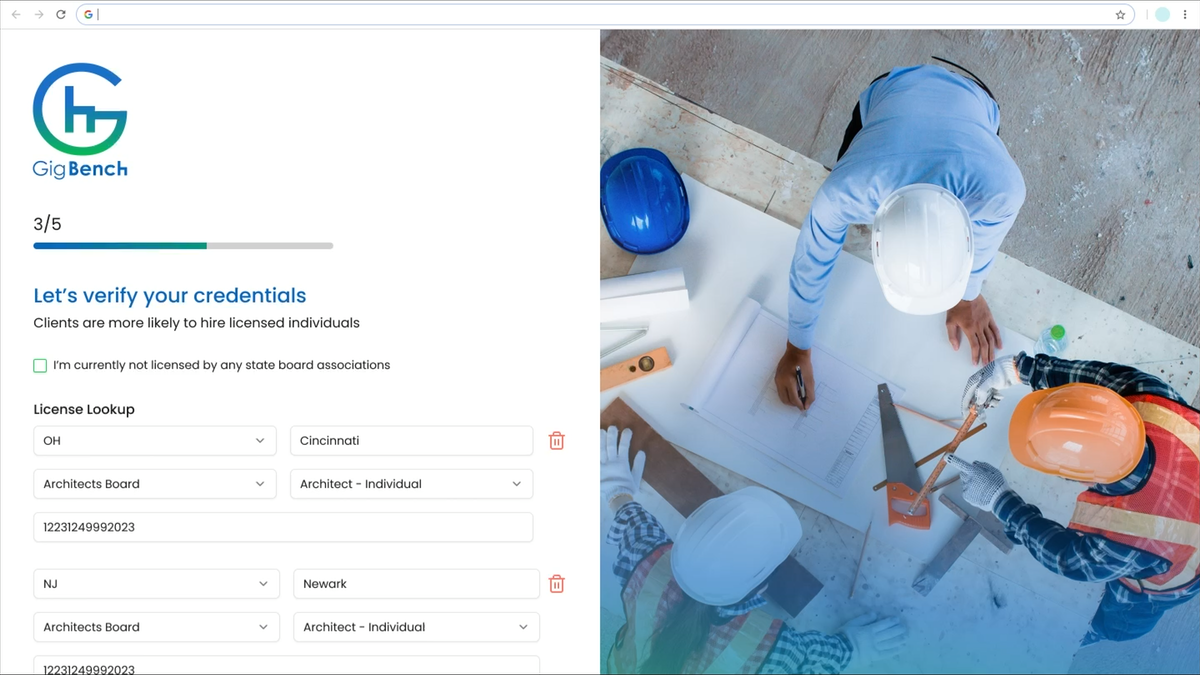
Onboarding is where the whole thesis is visible: five steps, and the third one is a license lookup against state board records.
03
Research
The friction wasn't in the search. It was in the handshake.
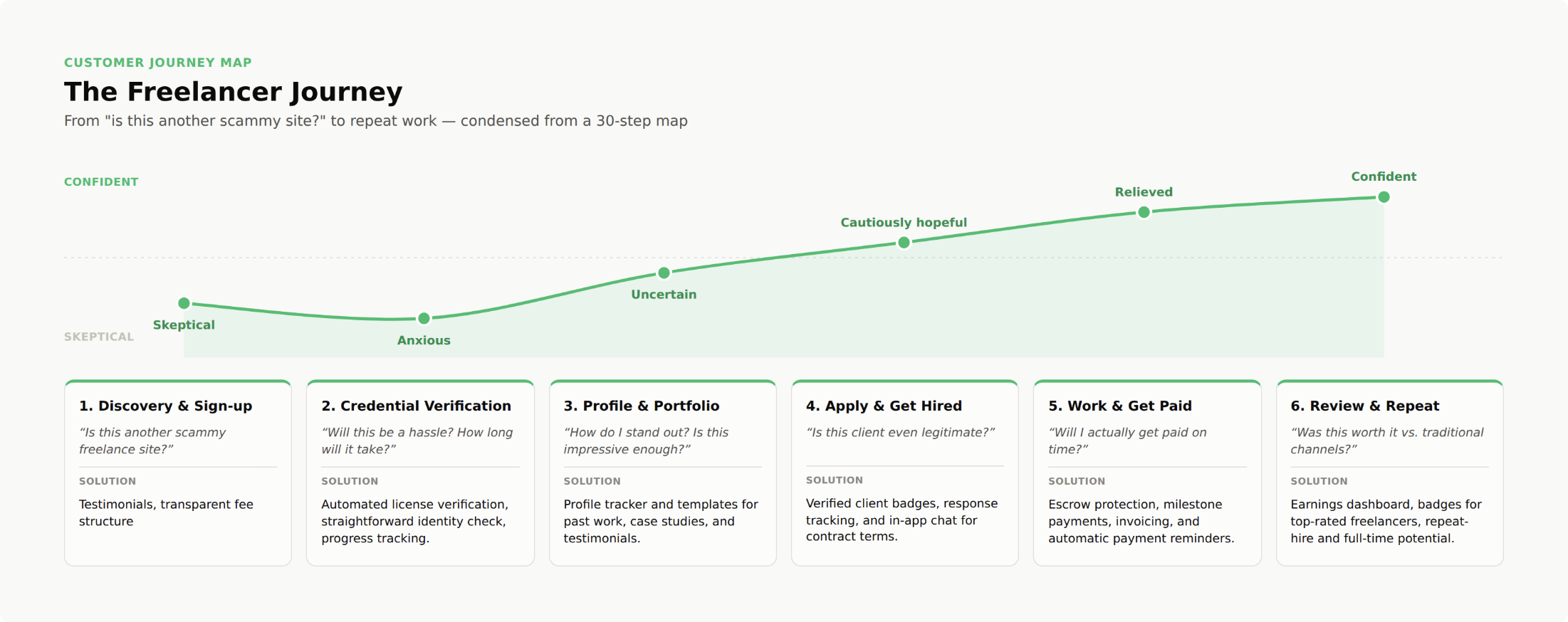
We wrote the research plan and interview guide and handed it to the client to run. From what came back I mapped both journeys end to end — the freelancer's and the hiring company's — looking for where confidence broke down rather than where clicks piled up.
The two curves bottom out on the same step, from opposite sides. Freelancers go anxious at credential verification; firms go distrustful reviewing those same credentials. One moment, two kinds of doubt — which is what made two-way verification the MVP rather than a later phase.
04
Scope
Budget was tight, and the client kept adding features.
Working from user stories and flow diagrams built with our business analyst and product strategist, I translated discovery into UI direction: onboarding, matching, and the collaboration tools both sides would need once trust existed.
The requests kept coming, and none of them had user data behind them. Rather than argue taste, we ran a prioritization exercise and weighed every ask against the competitive research and the two journey maps.
Search sophistication doesn't matter if firms don't trust the platform enough to sign up in the first place.
The line that settled it. Two features left MVP scope that afternoon.
05
The MVP
Three pillars, and all three of them are trust.
Verification on both sides: licenses, certifications and work history for freelancers; website and Stripe banking checks for companies. AI matching that reads the verified evidence rather than the self-description. And collaboration tools — secure messaging, document exchange, invoicing — so the relationship has somewhere to live once it starts.
06
System
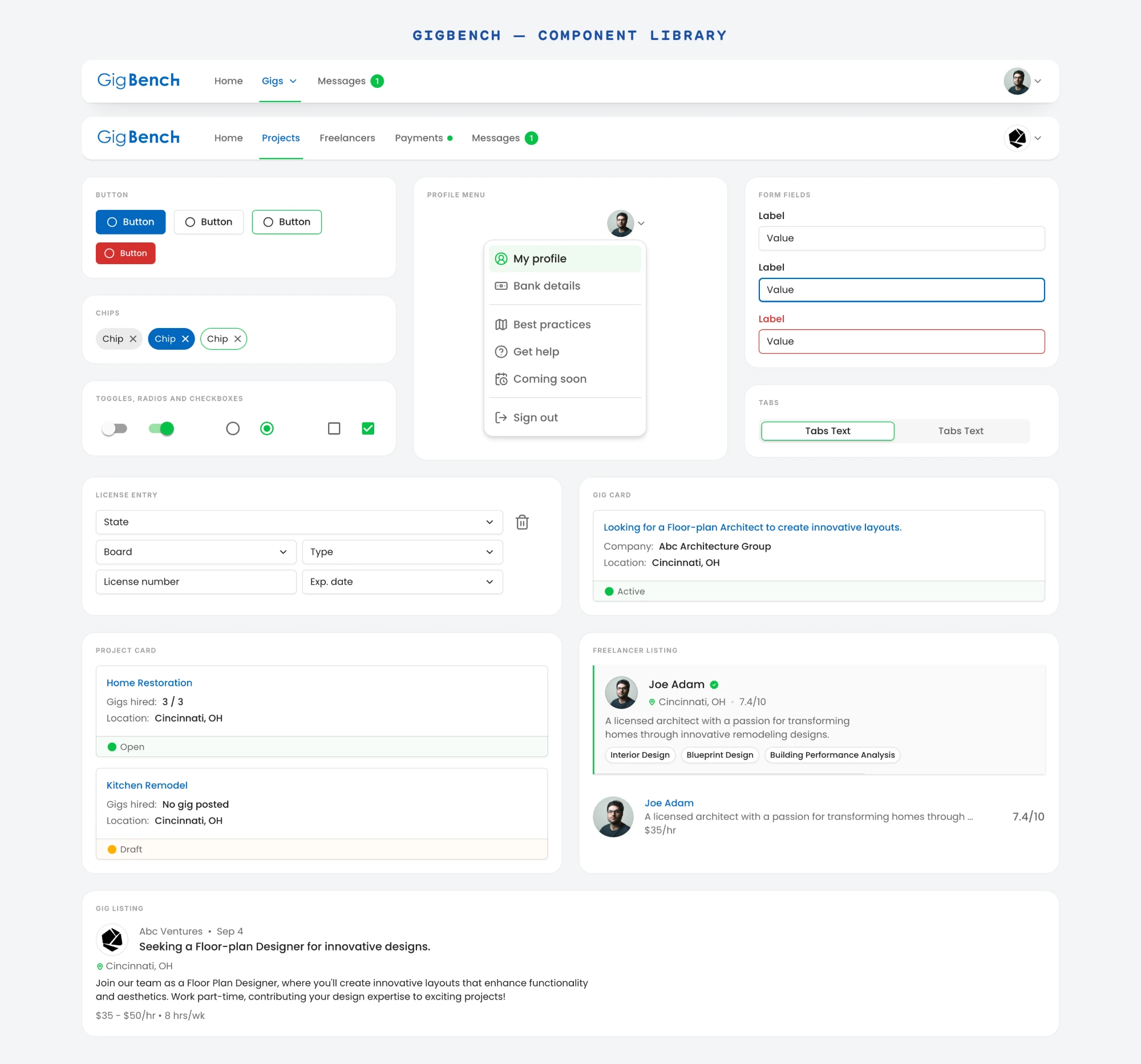
One component library, not six one-off screens.
Buttons, form fields, chips, tabs, license-entry rows and the verification badge all got built once and reused everywhere they applied — so a licensed-architect card reads the same whether it's in a search result, a gig listing, or a freelancer's own profile. That consistency mattered more here than on a typical product: the pitch is trust, and a verification badge that renders differently screen to screen undercuts the argument before anyone reads a word of copy.
07
Results
The concepts alone were enough to unlock the build.
Discovery was meant to produce a direction. It produced a commitment — the client funded the full product off the back of it, and the MVP then shipped on time and on budget. Growth since has been entirely organic.
200+
Freelancers and hiring firms on the platform, grown with no paid acquisition
Funded
Discovery concepts turned a scoping engagement into the full product build
On time
And on budget, to the scope we defended in the prioritization exercise
Takeaway
Trust, not speed, was the right thing to design for first.
The industry's resistance to freelancing was never an obstacle to work around — it was the evidence that the starting assumption held. Verification and a blind two-way review weren't nice-to-haves; they were the reason anyone was willing to try the platform at all.
The part I'd carry into the next project is the prioritization exercise. Saying no to a paying client is much easier when the research says it for you.